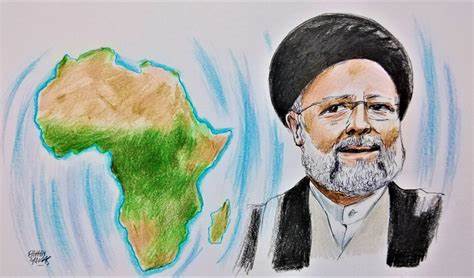
The West imposed harsh economic sanctions on Iran; Because of its nuclear program and ambition, which placed it in political isolation, it negatively affected its international relations for more than two decades. However, recent Iranian foreign policy interactions have revealed the desire of its leaders to break this isolation and overcome these sanctions, which prompted them to begin a wide-ranging process of openness, aimed at restoring and restoring its relations with the outside world, including its relations with African countries. The previous presidents of Iran – although they varied among themselves – paid great attention to Africa, with the exception of President Hassan Rouhani, who greatly diminished Iranian activity in Africa during his presidency. When President Ebrahim Raisi came, he began his presidency by stressing the importance of the continent, and his administration’s keenness to restore and strengthen it. And developing Iranian-African relations. and then; The helicopter crash of Iranian President Ibrahim Raisi on Sunday, May 19, 2024, which claimed his life and all those who were with him, is of great importance and makes us raise many questions about the repercussions of this incident on the file of Iranian foreign policy towards Africa. What is the history of Iranian-African relations and their motives? How can we understand the features of Iranian foreign policy towards Africa during Raisi’s era? How might Raisi’s killing affect those relationships? These are the questions that we will seek to answer during this report.
Iran and Africa..
Since the Islamic Revolution, the Islamic Republic of Iran’s interest in Africa began, but over the forty-five years that followed the revolution, some changes occurred in Iran’s policy towards the continent as a result of developments in Tehran’s internal and external arenas. However, Iran’s strategic goal has been clear since the establishment of the Islamic Republic. ; It is to highlight Iran as a power that goes beyond being a regional power, and to put pressure on its competitors, especially the United States, in other geographical regions to obtain political and economic advantages, mitigate the impact of sanctions on it, and neutralize the strategy of political isolation directed at it by forming a network of strong alliances. Therefore, Iran pursued a “pivot to Africa” policy in response to the need to combat sanctions and export its revolutionary outlook to the world. In this context, Iran aimed to combat regional and international isolation by forming partnerships with states, autonomous regions, and non-state actors, and by simultaneously using hard and soft power tools in Africa; To expand its geographical influence across the continent. Within the framework of that vision, Iranian leaders have committed over the past decades to consolidating their influence in the African continent, despite their different mechanisms for achieving this goal. We find that Ibrahim Raisi, since taking office in August 2021, has focused on a foreign policy consistent with Khamenei’s view of the world, as Khattab called for Khamenei calls for a radical diversification of Iran’s foreign policy toward emerging Asian powers, former European colonies in Africa and Latin America, and, more broadly, countries of the Global South. Khamenei’s doctrine does not limit Iran’s geopolitical reach to its immediate neighborhood; Rather, it calls for the sponsorship of resistance blocs around the world. Therefore, Raisi encouraged Iranian-African cooperation, and this was clearly evident in his repeated statements about his government’s insistence on employing the country’s diplomatic resources in efforts to activate cooperation with African countries, in contrast to his predecessor Hassan Rouhani, who neglected cooperation with the African continent as a strategic priority. Rather, his foreign agenda revolved around Lift sanctions by seeking agreement with the United States; Which made interest in Iranian interests in the African continent decline.
1. History of Iranian relations with Africa : As soon as the regime stabilized in Iran in the wake of the 1979 revolution, politicians headed to African space to strengthen their relations with the countries of the continent. Iranian officials’ visits to African countries continued and were repeated, especially at the level of heads of state. President Ali Khamenei (1981 – 1989) visited Africa 7 visits to 6 countries: Libya and Algeria in 1984, and Tanzania, Zimbabwe, Angola, and Mozambique in 1986, then he returned to Zimbabwe in the same year. Then the next president, Ali Akbar Hashemi Rafsanjani (1989 – 1997), continued his interest in Africa, making 8 visits to 7 countries: Senegal and Sudan in 1991, Kenya, Uganda, and Sudan for the second time, and Tanzania, Zimbabwe, and South Africa in 1996. After that, the interest of the next president, Muhammad Khatami, increased ( 1997-2005) in the African Department, where he made 10 visits to 10 countries: South Africa in 1998, Algeria and Sudan in 2004, Nigeria, Senegal, Sierra Leone, Mali, Benin, Zimbabwe and Uganda in 2005. At the highest level of interest, the next president, Mahmoud Ahmadinejad, visited Africa 21 visits to 16 countries. They are: Gambia and Senegal in 2006, Sudan and Algeria in 2007, Senegal for the second time in 2008, Kenya, Comoros, Djibouti, Gambia for the second time, Senegal for the third time in 2009, Zimbabwe, Uganda, Mali, Nigeria and Algeria for the second time in 2010, and Mauritania and Sudan for the second time in 2011. Egypt, Benin, Niger, and Ghana in 2013. After that, the Iranian presidency was absent from the African scene, during the era of President Hassan Rouhani (2013-2021), then it returned again with President Ibrahim Raisi, and after two years of his rule, he began visiting African capitals in July 2023. Raisi participated in talks aimed at strengthening parliamentary cooperation with the National Assembly in South Africa (Iran’s largest trading partner in sub-Saharan Africa), as well as in Guinea-Bissau, and several months later, specifically in January 2022, Raisi hosted the Togolese Foreign Minister Robert Doocy, in Tehran; To discuss the future of economic and trade partnerships between the two countries. Last July, Raisi toured three African countries, including Kenya, Uganda, and Zimbabwe.
2. Tools of Iranian influence in Africa: Iran has gradually built influence in Africa through successive diplomatic, political, security, maritime, commercial, and cultural exchanges. To achieve its strategic goals, Iran uses different policies at the tactical level to penetrate into the African interior: the first; Soft power: Since the Islamic Revolution, Tehran has carried out these activities through key institutions, such as the Mostazafan Foundation, the Iranian Red Crescent, the Ministry of Islamic Guidance and Culture, the Islamic Culture and Communication Organization, and Al-Mustafa University. In addition to these institutions, parliamentary groups, friendship societies, chambers of commerce, charitable organizations, religious institutes and universities participate in establishing close relations with the peoples of the African continent, and providing various types of support to the countries and groups of the continent through development programmes. Iran has also been active in building Shiite movements in Ivory Coast, Liberia, Cameroon, Nigeria, and Sudan. Secondly; Penetration through Iran’s terrorist arms: The Quds Force, affiliated with the Revolutionary Guard, was tasked with carrying out cross-border operations, expanding the country’s strategic depth beyond the Middle East into Africa; Through a number of mechanisms, such as arms smuggling, oil smuggling, as well as providing weapons to terrorist groups, and educational activities. And third; Direct Intervention: Iran is developing its relations with state and non-state actors on the African continent at three levels: If the country belongs to a religion other than Islam, Iran provides humanitarian aid that directly meets the needs. If the opposing party is Muslim and not Shiite, Iran emphasizes unity, arguing that sectarian differences do not matter and that there must be a united front against the enemies of Islam. As for the third level of interaction with African countries, it occurs if the targeted state is Shiite, as direct efforts are made to build a proxy force within the axis of resistance. However, if the interaction is with opposition groups that are subject to the structure of a strong central state, then propaganda activities are conducted to achieve Iranian gains in the targeted state. But if the opposition group is under the structure of a failed state, the path to arms and military equipment trade will be followed. And fourth: Official visits: Iran relied on strengthening its official relations with African countries, especially during the era of the late President Ibrahim Raisi. Fifthly; Economic penetration: Tehran gives priority to the comprehensive development of relations with African countries, and this trend is reinforced by the holding of the first conference on scientific and economic cooperation for Iran and West African countries in March 2023 in Tehran. During this conference, 20 multilateral and bilateral agreements and memorandums of understanding were signed between Iran and West African countries. In order to expand and deepen comprehensive economic cooperation, it was followed by the Second Iran-Africa Economic Conference, which was held in Tehran at the end of last April in the presence of representatives from more than 30 African countries. In addition, Tehran celebrates its partnership with Africa through the work of about 10,000 Iranian companies in the technological and scientific sectors, which has raised Iran’s total trade with African countries to the level of two billion dollars annually. Sixth: Arms smuggling network: When Sadio Camara, Minister of Defense for Veterans Affairs of Mali, visited Iran in May last year, Iran confirmed its ability to supply Bamako with military equipment and exchange experiences in the war on terrorism, while in February 2024 reports emerged that the side The Iranians were supplying the Sudanese Armed Forces with advanced combat drones for use against the Rapid Support Forces, and it was believed that in this way Tehran hoped to gain access to the port of Port Sudan, a facility that would provide the ability to project force in the Red Sea. Perhaps the most dangerous thing about the illegal arms smuggling network that Iran has been able to build in the Horn of Africa is that it allows Tehran to smuggle weapons and supply them to governments and non-state actors. With the export of weapons to countries on the continent, such as supplying the Ethiopian army with Migrant-6 drones, and supplying the Sudanese army with drones of the same model, it seems that Tehran is planning to increase its sales of these drones to the African continent.
3. Motives and reasons for Iran’s move toward Africa : The reasons for this ambitious Iranian move can be summarized in several points: The first is; Political messages to the West: The Iranian nuclear program was the reason for the United States and its allies to impose one sanctions after another on Iran. The turbulent international contexts, especially the Russian-Ukrainian war, have increased the difficulty of this matter. and then; Iran has intended to send strong, practical messages to the West through its openness to the outside world, including the African arena. To emphasize its ability to break its international isolation and mitigate the extremely negative effects of the Western sanctions imposed on it, away from the pressure card of the nuclear issue. Secondly; Supporting Iran and strengthening its position in the international system: The international system is currently subject to delicate operations, which will undoubtedly change its features greatly, and from here all international actors are taking the initiative to collect reasons that will strengthen their position in the future in the expected new international order, and there is an unintended international consensus. For its own sake, the presence in the African space is considered one of the most important of these reasons. African voices in international community forums have a significant influence, and from here Iran seeks to gain the largest amount of these African votes on its side. And third; Maximizing economic returns: Iran seeks to secure and diversify its sources of natural resources, such as agricultural products and minerals. It also seeks to obtain uranium ore to feed its nuclear program, at a time when Africa is considered, on the one hand, the world’s first food basket, and the world’s largest mine of hydrocarbons, minerals, and important elements. , especially the element uranium; It possesses an estimated 18% of the global reserve. On the other hand, the unstable political and security environment in Africa helps the smuggling of all goods, including uranium. On the third hand, Africa is the largest market in the world for importing goods and services, from which the economies dealing with it reap huge profits that are difficult to achieve anywhere else in the world.
Raisi and Africa..
According to the Iranian Foreign Ministry, the goal when President Ebrahim Raisi first came to power was to increase trade with Africa to more than two billion dollars annually, and to break the international isolation imposed on it by the United States after then-US President Donald Trump abandoned the nuclear agreement in 2018, and re-imposed Sanctions, as well as improving his country’s image on the continent after his predecessor, Hassan Rouhani, ignored them. Therefore, Tehran focused on the countries of the Horn of Africa in its narrow sense: “Somalia, Eritrea, Ethiopia, Djibouti” and in its broad sense, including Sudan and Kenya. In addition to the desire to restore diplomatic relations with some African countries; Such as: Sudan and Djibouti after they cut it off in support of Saudi Arabia in its famous dispute with Tehran in 2016. So, in July 2023, the late President Ibrahim Raisi made the first tour by an Iranian president to the continent in more than 10 years, which included Kenya, Uganda, and Zimbabwe, a visit that Tehran described as It is a “new beginning” in relations with the continent, as several memorandums of understanding were signed in areas such as energy, agriculture, information technology, and industry. His deputy, the “current interim president,” Mohammad Mokhber, was also entrusted with heading a special working group to promote Iranian exports in Africa. Tehran also succeeded last year in restoring diplomatic relations with Djibouti, and Tehran also sought to consolidate its relations with Sudan, whether during the era of Al-Bashir, or after his overthrow. To find an outlet on the Red Sea, “Port Sudan Port,” through which it can supply the Houthis with weapons, especially after the “Al-Aqsa Flood” battle and the escalation of their attacks in Bab al-Mandab.
1. Features of my president’s foreign policy towards Africa: My president’s foreign policy towards Africa was manifested in several features: the first: Supporting the African Sahel coups: Raisi took advantage of the rejection of French and American influence by the coup leaders in the Sahel region (Mali, Burkina Faso, Niger), and presented his country as one of the supporters of these regimes that rejected colonial domination, in reference to Paris and Washington, so he praised, after the Niger coup, “ “By these African countries’ resistance to hegemonic European policies and colonialism.” Last January, during a meeting between the current Iranian interim president, Mohammad Mokhber, in Tehran, with the prime minister of the coup in Niger, Mokhber affirmed his country’s condemnation of what he described as “the harsh sanctions imposed by the hegemonic regime.” Emphasizing his country’s participation: “The experiences we have in this field are with our brothers in Niger.” It is said that Tehran aims through this rapprochement to obtain a share of Niger’s uranium (300 tons). Secondly; Confronting Sunni jihadist movements: After the completion of the withdrawal of French forces from Mali in August 2022, one of the reasons for their presence was to confront jihadist groups in the north allied with the Tuareg movement wishing for the secession of the north, the late Iranian Foreign Minister Hossein Abdollahian visited Mali. During the visit, Abdullahian spoke about “Mali’s important position in Tehran’s foreign policy,” his “confidence in opening a new chapter in the new relations between the two sides, and his country’s readiness to provide support to the Malian government to confront these “armed Sunni” jihadist organizations, which was also emphasized by the Minister of Defense. Muhammad Reza Ashtiani, during his meeting with his financial counterpart in May 2023. Third: Employing developments: A major work on exploiting political and military developments for the benefit of his country. The latest and most prominent example of this is his exploitation of the official and popular African rejection of the Zionist aggression on Gaza after the “Al-Aqsa Flood,” for the benefit of his country on the continent, where he worked to present Tehran as one of the most prominent and fundamental supporters of the resistance in Gaza in rejection. injustice and aggression, and to demand the right to self-determination, which is one of the basic principles on which the Organization of African Unity, and later the African Union, was founded. He also worked to exploit the recent Russian-Iranian rapprochement, especially in the field of security and arms supply, as one of the entry points in consolidating its relations with the countries of the continent, taking advantage of his country’s prior alliance with Moscow in Syria, and later in the Ukraine war. Here, Iran began to present itself as one of the alternatives to arms suppliers, especially with regard to the marches that had previously proven effective in Ukraine, and in Ethiopia’s war against Tigray.
Raisi’s killing and its impact on Iran’s policy towards Africa..
The names who were accompanied by the late Iranian president on board the helicopter were: Hossein Amir Abdollahian, Minister of Foreign Affairs, Al-Hashim Imam of Tabriz Friday, Malek Rahmati, Governor of East Azerbaijan, Seyyed Mehdi Mousavi, head of the President’s Protection Unit, a member of the Revolutionary Guard, in addition to the pilot, co-pilot, and an official. Technical. Upon closer examination of the names mentioned, we will find that at least three names played major roles in Iran’s foreign files in general, and towards Africa in particular, led by the late president and his foreign minister. Abdullahian, for example, had obtained a master’s degree and a doctorate in international relations from the University of Tehran, and spent five years as Deputy Minister of Foreign Affairs for Arab and African Affairs from 2011 to 2016, a period that witnessed many Arab and African interactions alike, before he took over the presidency. His last position as Minister of Foreign Affairs in August 2021 until his death. All these years, Allahian has been placing Iran’s relationship with its neighbors at the top of his priorities, including Arabs and Africans in particular. It is a different approach from that of his predecessor, Mohammad Javad Zarif. His tenure at the Iranian Ministry of Foreign Affairs witnessed a degree of stagnation in Iran’s policy towards Africa.
1. The fate of Iranian-African relations after Raisi’s death: Speculation abounds about the repercussions of the killing of Iranian President Ebrahim Raisi on Tehran’s foreign relations, especially with the African continent. The pace of development of relations between Iran and Africa may decline. In view of the developments in the political situation in Iran, and the arrangement of the scene inside Iran after the incident of the president’s death. However, after the situation stabilizes inside Iran and the election of a new president, Iran’s priority will likely be to seize the opportunity of tense relations between the West and African countries, especially those located in West Africa. To fill the security and economic vacuum; To strengthen Tehran’s presence and extend its influence in West Africa. The next stage after Raisi will not change with regard to the approach taken by the Iranian leadership, as the primary determinant of the nature of the political system rests with the Supreme Leader of the Iranian Revolution, who determines the direction of the state. Therefore, the next president of Iran will continue to implement his directions, and among the most prominent of these directions is the strengthening of relations between Iran and African countries, especially those countries whose relations with the West are characterized by tension. Therefore, Iran will return to employing all its hard and soft tools to enhance Iran’s image in the African continent as an alternative development model to Western countries. This will lead to achieving a number of strategic gains for Iran, the most important of which is strengthening Iran’s political influence in Africa, diversifying its trade partners, and opening new markets for its products on the African continent, which has great economic potential, in addition to breaking the economic isolation imposed on it, and reducing the impact of Western sanctions on Its economy. The scenario of the return of close relations between Iran and African countries, and that they will not be affected by the death of the Iranian president, is evidenced by the fact that less than a week after the horrific incident of Raisi, Sudanese Foreign Minister Hussein Awad and Acting Iranian Foreign Minister Ali Bagheri agreed during a meeting between them in Tehran on May 25. The past, to accelerate the process of reopening the embassies of the two countries, which ended the state of anxiety revealed by the reactions of African leaders and governments after the death of Iranian President Ibrahim Raisi, who was known for his determination to restore Iran’s presence and influence in Africa, whether through the Shiite tide or the tide. The real economy, or even the military expansion of some extremist groups. However, this does not prevent each president from adding his own touch to these relationships, and therefore; It can be said that there will be a set of constants and variables in the relations between the two sides.
2. The constants in Iran’s post-Raisi policy towards Africa : Despite the difficulty of having governing constants in foreign policy in general; However, the following aspects are considered basic pillars of Iran’s foreign policy towards Africa, even despite the relatively different orientations of successive administrations: First: The constant need to secure a foothold on a continent that is attractive to major external powers, and to win the African voting bloc in its favor in various international forums. Secondly; Reviving and activating the diplomacy of joint summits, as in the Tehran summit in April 2024, which aimed to expand the area of economic cooperation with African countries. And third; Taking even one step forward on the path to establishing its first military base in Africa, by following up on all the ongoing interactions in the various African sub-regions, which are characterized by a conflictual nature at the expense of a cooperative nature, including those highly turbulent areas that are considered a favorable environment for penetration, Then, it allows the establishment of foreign military bases on its territory in exchange for obtaining financial and other material advantages. And fourth: Opening new horizons for Iranian arms deals in the most turbulent regions of Africa, as Iran is trying to exploit the complex situations in some African countries to conclude secret and declared arms deals in some of those regions. The first of these was not the Tigray war, and the ongoing civil war in Sudan will not be the last. It recently provided the Sudanese National Army with marches to resolve some battles in Khartoum.
3. The change in Iran’s policy towards Africa after President : Although there is a ceiling that successive Iranian administrations cannot deviate from due to the established system of government, there is nevertheless a degree of relative variation in the orientation of each ruling administration individually, depending on the arrangement Its interests and the challenges posed by reality in each context. Among the files that may witness change are those related to Africa, which may witness change from successive Iranian administrations: the first of which is; Advances and delays in the arrangement of Iranian interests in Africa, which are limited to three interests: security and military interests, economic interests, and religious interests. Secondly; The position of the Shiite tide in Iran’s foreign agenda towards Africa, as successive Iranian administrations do not agree in viewing this issue as a matter that comes at the top of the list of priorities. The evidence for this is its opening of bilateral and trilateral relations with countries where Islam does not represent a majority, such as: Kenya, Ghana, and Uganda, even if they have slight Shiite representation. And third; The nature and limits of its African partnerships, including support for joint projects and activities outside the dollar cover, as successive administrations of Iran do not neglect the issue of concluding bilateral and collective partnerships with Africa, but the limits of these partnerships are what vary from one administration to another. For example, the period of Raisi’s rule witnessed a great rapprochement in Iran’s relationship with South Africa. In addition, Iran worked to build relations with African countries facing Western sanctions, where, for example, it obtained uranium from Zimbabwe in exchange for oil. And fourth: The nature and limits of its competition with the Gulf states and Turkey in Africa, which varies from time to time depending on the foreign policy priorities of those countries and changes in the international system. Fifthly; The form and nature of Iranian support for some African issues. During Raisi’s visit to Uganda as part of his African tour in July 2023, he supported Uganda in its anti-homosexuality law and arranged life imprisonment as a punishment for this crime, and denounced the widespread Western condemnations of the Ugandan law. Despite Iran’s position in support of Uganda in this issue; However, Iran has other positions that are seen as contributing to creating a state of turmoil and instability in other African regions and files. Morocco, for example, severed its relations with it in 2018, citing the fact that it had discovered evidence of Iran providing military training, supply and supply to the Polisario Front, which called for secession from Morocco. The same applies to Iranian arms shipments that reached non-governmental parties through agents in Somalia, in addition to the security services in Ghana, Senegal, and Tanzania arresting people suspected of belonging to the Quds Force, a branch of the Iranian Revolutionary Guard.
Conclusion; Africa will remain an attractive target for international and regional powers, and will remain a pivotal determinant in Iran’s relationship with Western countries. In contrast to the rule of former President Hassan Rouhani for two consecutive terms, where Iran’s relations with Africa declined, the late President Ibrahim Raisi indicated that Africa would be a priority in his foreign and economic relations, and since assuming power in 2021, he has focused on strengthening relations with the East, especially with Russia and China. And the trend towards establishing relations with countries of the Global South, especially with Africa and Latin American countries. The ruling system in force in Iran leaves a limited space for change in general for any of the successive administrations. The circle may expand slightly with regard to Iran’s foreign policy. However, it is not imaginable that it will witness a radical change from one administration to another. This is provided, of course, that the variables remain constant under the current leadership. On the other hand, it can be said that the late Iranian President Ebrahim Raisi, despite his short years in power; However, he succeeded in moving the stagnant waters between Iran and Africa, and perhaps an indication of this, for example, is the African reactions following the crash of his helicopter and the official announcement of his death. Therefore, regardless of the name of the next Iranian president after the completion of the current transitional phase; It is envisaged that a change in Iran’s foreign policy towards Africa will affect only the branches with regard to the nature and limits of its partnerships with Africa, and which African countries it considers to be pivotal countries, but it is unlikely that this change will affect the roots. It is as if it has become more involved in Africa, and has begun to openly play roles in favor of any of the conflicting parties, as Russia or France do, for example. In both cases, Africa remains for Iran an indispensable player in its extended battles with the United States and the West.