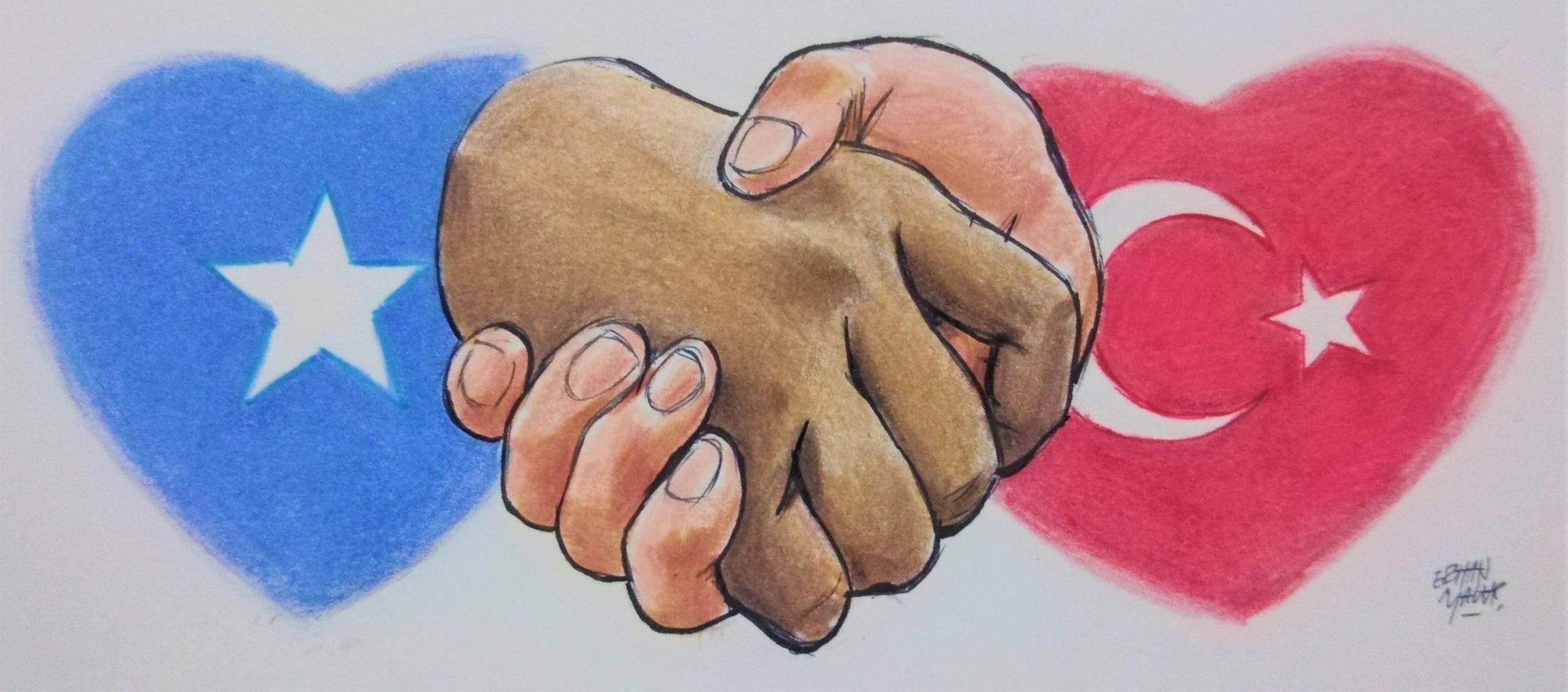
Relations between Somalia and Turkey have witnessed significant growth recently. Through the new agreement that was signed and launched last February, the importance of this growth in relations comes from the standpoint of Turkey’s growing strategic ability and influence, in addition to the importance of Somalia’s strategic location, which almost completely dominates the Horn of Africa region by land, air and sea. The importance of Turkish-Somali movements and actions increases due to the increasing security and military risks and threats in the Horn of Africa and the Red Sea. What is the historical framework of these relations? How can we understand the expansion of Turkish influence in the recent period in the Horn of Africa region through the growth of Turkish-Somali relations? How can the Egyptian role be understood in this context? These are the questions that we will try to answer during this report.
The historical framework of relations between Turkey and Somalia: Relations between the two countries passed through four stages: Firstly, The period from 2002 to 2011: In this period, diplomatic representation was restored between the two countries after Turkey had closed its embassy in Mogadishu in 1991 with the beginning of the civil war in Somalia, but relations at this stage were limited to focusing on Turkish humanitarian aid to alleviate famines and economic crises in Somalia. . At this stage, relations between Somalia and Turkey remained relatively limited, and therefore the volume of Turkish exports to Somalia in 2010 did not exceed only $5.1 million. Secondly, The period from 2011 to 2015: Turkey opened its largest embassy abroad in Mogadishu in 2011, and Somalia responded in kind by opening an embassy in Ankara. During this period, Turkey significantly increased its aid to Somalia, including in the areas of health care, education, hospital and school construction, and infrastructure projects. Turkish Airlines began direct flights to Mogadishu, strengthening economic relations. Thirdly, Period from 2016 to 2020: Relations between Türkiye and Somalia continued to develop. In 2016, Somali President Hassan Sheikh Mohamud visited Turkey, and the two countries signed several agreements for cooperation in various fields, including defense and security. In 2017, Türkiye opened in Mogadishu the largest Turkish military training base outside Türkiye. To help train Somali forces, and because of the capacity of this base, it can train up to 1,500 soldiers in one training session. Türkiye’s total exports to Somalia amounted to $150 million, while imports from Somalia amounted to $5.5 million. In 2020, Türkiye sent medical aid to Somalia to confront the Corona pandemic. In the same year, Ankara signed an agreement to explore for gas and oil in Somali waters and mediated between Somalia and Kenya to reach an agreement to demarcate their common maritime borders. Ankara established a space base in Somalia at a cost of $350 million to launch satellites from. Fourthly, the period from 2021 to 2024: This is the stage that has reached the level of strategic partnership. It witnessed the signing of a comprehensive defense and security cooperation agreement in 2024. The security and military relations between Turkey and Somalia emerged more clearly at the end of 2022, when Hussein Maalim Mohamud, the National Security Advisor to Somali President Hassan Sheikh Mohamud, revealed the participation of the Turkish “Bayraktar 2” drones. “In the war his country is waging against Al-Shabaab.
February 2024 Agreement: On February 8, 2024, Turkey and Somalia signed an agreement for defense and economic cooperation and combating terrorism for a full decade, during the visit of Somali Defense Minister Abdelkader Mohamed Nur to Ankara. The agreement was described as historic, as it includes various military, economic and humanitarian aspects. Under the agreement, Ankara must protect and secure the coast of Somalia in exchange for granting Ankara the right to exploit 30% of the wealth of the Somali coast, the longest on the African continent. The agreement includes combating piracy crimes, preventing foreign interference, illegal fishing and arms smuggling, and training and building the Somali naval forces and supplying them with equipment. The Somali government, through Information Minister Daoud Awis Jama, saw the agreement as a protection for its sovereignty, while Prime Minister Hamza Abdi Barre considered that it “puts an end to Somalia’s fears of terrorism and pirates, and prevents external threats and violations.” Although the President of Somalia, Hassan Sheikh Mohamud, confirmed that “the agreement does not target any third party,” among several important indications of the timing and dimensions of its signing, it came about a month after an agreement between Ethiopia and the “Somaliland” government early last January, stipulating the leasing of Addis Ababa. “Berbera” port from Somaliland to find an outlet on the Red Sea, which Mogadishu and Ankara rejected, as “a direct attack on the sovereignty of Somalia, and as threatening to inflame the situation and instability in the Horn of Africa region.” Somali President Sheikh Mohamud made a phone call on January 5 with his Turkish counterpart, who called for an end to “the worrying tension between Somalia and Ethiopia on the basis of Somalia’s territorial integrity,” stressing that “cooperation between the two countries will continue gradually.” Turkey also issued a statement confirming its strong rejection and denunciation. For the memorandum of understanding that Ethiopia signed with the Somaliland government, because it is “an attack on the rights and interests of the Somali people,” which also means that the agreement aims to deter Ethiopia’s efforts to reach the sea through the separatist Somaliland and reinforces the growing Turkish presence on the African continent. It is noteworthy that Turkey operates a number of major sea and airports in Mogadishu, as it built and managed Mogadishu Airport, and this provides 80% of the Somali government’s revenues. Therefore, the agreement means that Turkey will be present in the Red Sea and expanding in it and will not be satisfied with the coasts of Somalia that extend from the Indian Ocean, the Gulf of Aden, and Bab al-Mandab, with all the repercussions that result from that, which the United States of America was aware of, so it left only one week after the agreement. The defense agreement between Turkey and Somalia led to the signing of a security agreement with Somalia on February 15, under which Washington pledged to provide high-level training and qualification to the Somali National Army, and to develop the capabilities of the Deneb Brigade, known locally as the “Lightning Forces,” to enable it to confront the country’s security challenges. This is in addition to building 4 military training centers in Mogadishu, Baidoa, Jawhar, Tusmarib and Kismayo. The Somali Parliament, with its two chambers, the People’s Assembly and the Senate, approved the agreement in an extraordinary joint session. 213 members of the Federal Parliament voted in favor of the agreement, while 3 members out of 331 members of both houses of the Somali Parliament rejected it.
The timing and reasons for the agreement: The agreement came at a time when tensions between neighboring Somalia and Ethiopia in the Horn of Africa increased since the rapprochement between Ethiopia and Somaliland, which was embodied by the signing of a “memorandum of understanding” on the first of last January, stipulating that Ethiopia would lease the coast of Somaliland extending for 20 km on the Gulf of Aden for 50 years. In turn, Mogadishu denounced the “illegal” agreement. The Somaliland authorities confirmed that in exchange for this access to the sea, Ethiopia would become the first country to officially recognize it, which no side has done since this small region – with a population of 4.5 million people – unilaterally declared its independence from Somalia in 1991. Its reasons can be summarized in the following points: the signing of the memorandum of understanding between Somaliland and Ethiopia as a step to recognize Somaliland as an independent entity, and this is what angered the Mogadishu government, and Ethiopia’s access to warm waters and guaranteeing a sea outlet in the Red Sea in Somali waters in exchange for recognition of Somaliland, which creates an imbalance in Regional balances in the geopolitics of the Horn of Africa, threatening Arab national security, increasing Houthi attacks on ships loaded with goods in the Red Sea, in addition to the smuggling of weapons from the Houthis to extremist groups in Somalia, and finally the growing fears of security disturbances in Somali waters following the return of Somali pirate activity. This threatens international transit trade in Bab al-Mandab, which represents 5% of global trade.
Effects of the Agreement: This agreement could have an impact on the balance of power and regional and international interests in the Horn of Africa region, and it is expected in the foreseeable future to have direct repercussions on international actors and players in the region, and its effects can be summarized in several points: Firstly, Reassuring Somalia: This agreement represents a qualitative leap in strengthening its security and economic partnership with Turkey, which has a large presence in Somalia, especially since 2011, and its exploitation of economic and investment opportunities in Mogadishu, which has enabled it to gain primacy in presence and influence on the Somali security and political scene. Secondly, Ethiopian apprehension: With the announcement of the framework agreement between Mogadishu and Ankara, this news resonated in the circles of the Ethiopian elite, and this agreement also attracted the attention of the Ethiopian press. Future Ormia News Radio commented on the agreement with a mixture of signs of questioning and denunciation about the future of Turkish investments in Ethiopia, as it – that is, Turkey – is the second largest investor in Ethiopia after China. Thirdly, Emirati discomfort: The United Arab Emirates is a strategic partner for Somalia, especially with regard to security issues. It undertakes the task of training Somali soldiers in military training centers in Mogadishu and in the Puntland region, but the Turkish and Emirati military presence in Somalia has always been a source of tension and controversy since 2017, before Abu Dhabi was forced to stop its military cooperation with Mogadishu during the Gulf crisis in 2018, but it resumed. This relationship has been in place since Hassan Sheikh Mohamud was re-elected as President of Somalia for a second term, in May 2022, and the two countries signed a security agreement in Abu Dhabi in 2023, but the Somali Parliament has not yet ratified it, and for this reason, the Emirati policy towards Somalia is shrouded in many doubts and ambiguities – according to observers. – As it provides contributions and military support, specifically logistical, to the federal government in Mogadishu, and in return, Ethiopia is considered a strategic partner and one of the keys to ensuring its survival and extending its influence in the Horn of Africa, and it also has close cooperation with Somaliland, as the Dubai Ports Company works to manage the port of Berbera without approval from the central government. Therefore, the framework agreement between Mogadishu and Ankara could constitute an obstacle to the future of UAE investments in Ethiopia (estimated at about 3 billion US dollars) if Ethiopia’s efforts to reach warm waters fail, which represents a double blow with multiple dimensions for the UAE and Ethiopia at the same time. Fourthly,The consistency of the Turkish-American presence: With increasing fears of the expansion of the fires in the Red Sea and the escalation of crises in Bab al-Mandab as a result of Houthi and pirate attacks on ships loaded with goods heading to Tel Aviv, in addition to the Chinese and Russian presence in the region, the Turkish and American security approach in the region is moving towards… Coordinating roles in the Horn of Africa. To confirm this, Washington signed a memorandum of understanding with Mogadishu after the framework agreement between Somalia and Turkey, to build five bases for the Somali army, especially the “Deneb” unit. Therefore, the race for security cooperation diplomacy with Somalia and building military bases between Ankara and Washington is currently heated, in addition to their military presence in the Red Sea, within the framework of their membership as the two strongest members of the North Atlantic Treaty Organization (NATO).
The future of the agreement and its repercussions: The game of international competition in the Horn of Africa: The memorandum of understanding signed between Ethiopia and Somaliland was described as an important development, which increases the ignition of international competition in the region, which, as soon as its storms calm down, is renewed again, during the reaching of the “Pretoria” agreement in South Africa. In 2022 between the Ethiopian parties to quell the war in the Tigray region, Sudan quickly slid into the circle of war since April 2024, in addition to the security crisis in Somalia represented by the raging war between the federal government and the Al-Shabaab movement, as well as the Houthi attacks in the Red Sea, and the presence of military bases. In Djibouti for China, America, Japan and France, in addition to that, the Turkish trend towards this region is to conclude security agreements with Somalia and Djibouti, in coordination with international powers such as the United States of America and regional powers such as Ethiopia, which mixes the cards and geopolitical calculations in the region that has been facing international competition for decades. . The framework agreement signed between Mogadishu and Ankara reflects Turkish expansion in the territorial waters near the Gulf of Aden, and strengthens its presence in Somalia, the Gulf states (Qatar) and Yemen. Therefore, it is difficult to estimate the extent of the repercussions of the framework agreement between Mogadishu and Ankara on Turkey’s interests in both Ethiopia and Somaliland. The economic cooperation between Turkey and Ethiopia amounts to approximately 300 million US dollars annually, and the volume of its investments amounts to about 2 billion US dollars. 13 huge economic projects have been completed and managed by 20 Turkish companies that employ approximately 20,000 Ethiopians. There is also a Turkish consulate in Somaliland, and Turkish bodies implement development projects. In Hargeisa, it also has economic and diplomatic interests in Somalia; The largest Turkish embassy in Africa is located in Mogadishu, and the annual trade volume between the two countries is estimated at about 250 million US dollars. The Turkish company Albayrak has managed the Mogadishu port since 2014 and the Turkish Favori has operated the Mogadishu airport since 2015. The volume of Turkish investments in Somalia amounts to 100 million dollars. American. It also has security agreements signed with Ethiopia and provided it with Turkish marches following the Tigray war to contain the threat of the Tigray People’s Liberation Front. It is considered a reliable ally, and that is why Ankara could face a dilemma in reconciling its interests in Ethiopia and Somalia.
Turkey in the Horn of Africa: Given the strong relations and trade exchange between Turkey and the countries of the Horn of Africa, and through the use of its diplomatic tools and soft power, Ankara can play a mediation role to defuse tensions in the Horn of Africa region, between Somalia and Ethiopia, but there is great difficulty in convincing its ally. Somalia will enter into negotiations with Ethiopia unless the latter withdraws a memorandum of understanding with Hargeisa, and the withdrawal of this memorandum by Abiy Ahmed is not an easy matter at the present time, because it was considered a popular demand, drawing attention from internal rifts to an external crisis that has impacts and repercussions of various dimensions on stability. Region. Therefore, the burdens of the Turkish presence in the region face a difficult challenge and test in reconciling regional parties that are heading towards escalating their crises in a way that does not serve efforts to deter the region’s slide into civil war again. The most important achievement that will be achieved within the scope of the agreement, which concerns the entire international community, is the revitalization of the Somali naval forces through Turkish support. Within the framework of this agreement, work will be done to establish competent and self-sufficient Somali naval forces with the support of our Turkish friends. This process will create a domino effect. In a limited time, the highly skilled Somali naval forces will regain the dominance they lost after the civil war in the Somali seas. He will train the Somali Navy and the Turkish Navy, which is respected internationally. Therefore, the Somali Navy, in turn, will tighten its control over Somalia’s water outlets and territorial waters. It will also eliminate all types of illegal activities, whether local or external, in Somali territorial waters.
Egypt and the transformations in the Horn of Africa: Several months after the agreement concluded between Somaliland and Ethiopia, which was considered a natural response to the framework agreement between Mogadishu and Ankara, there are new variables in the geopolitics of the countries of the Horn of Africa with regard to the nature of the existing alliances and interactions. Egypt plays multiple roles in its attempt to corner Ethiopia in an isolated corner. Somalia has transformed from a security and commercial partner into a significant opponent for Ethiopia, given the diplomacy it is currently practicing in international and regional forums and the spotlight on Ethiopia as a source of unrest and chaos in the region, in line with the vision of Egyptian foreign policy towards Ethiopia. This is in addition to the more intertwined relations between Egypt and Eritrea after Afwerki’s recent visit to Cairo, in which the two presidents stressed the need to protect the sovereignty, independence and unity of Somalia, and before that, the visit of the Egyptian Foreign Minister, Sameh Shoukry, to Asmara, after Ethiopia’s desire to reach the Red Sea was exposed, and for this reason The geopolitics of the Horn of Africa can be divided into two axes: an axis led by Egypt and including Somalia, Eritrea, and Saudi Arabia, and another axis, led by the UAE, and including Ethiopia and Somaliland. The calculations of Washington, Beijing, and Ankara are present in the scene, to prevent Somalia and Ethiopia from going into a round of violent confrontations. Again, in an unequal war between the two neighbors.
Conclusion: There is no doubt that all these stages that the relations between Turkey and Somalia went through, and then what they have reached now in 2024; All of this makes it clear that these relations achieved the highest national interests for both countries. It gave Turkey great regional influence – militarily, security-wise, and then politically – in the Horn of Africa, the Red Sea, the Bab al-Mandab Strait, the Gulf of Aden, and the Arabian Sea, and all of this increases the cards that Turkey holds in the conflict and competition for influence, whether in the Middle East and East Africa, or Even at the international level. On the other hand, the State of Somalia has benefited from a strong political, military and economically – Turkey – in confronting the many challenges it faces in the economic, political and security fields from the deterioration of its economic resources and the escalation of terrorism and political and tribal conflicts, as well as the ambitions of regional powers such as Ethiopia, Kenya and others, or the ambitions of powers International such as the United States, France, China and Britain; Some of these regional and international powers support the division of Somalia, while others aspire to dominate the national will of the Somali Republic.
The signing of the defense agreement between Turkey and Somalia comes within the context of the Turkish strategy to expand its presence and influence on the African continent, diversify its economic relations, open new markets and investments in Africa, specifically Somalia and Djibouti, and expand beyond the traditional geography of Turkish role, presence and influence. The dimensions of the agreement aim to expand bilateral military and security cooperation between Turkey and Somalia, especially as it also aims to joint military exercises, and provide the necessary equipment to the Somali forces, including the Turkish “Bayrakdar” drones, in addition to exchanging intelligence information and cooperation against terrorism, which strengthens the Turkish role. Internationally and globally in Africa, especially after the decline of the European presence in general, and the French in particular, on the African continent, and prior to the departure of the African peacekeeping forces “Atemis” from Somalia in December 2024.